Powered by Blogger.

One (Kind) Kindergarten

Welcome back to the blog--I want to talk a little about our mornings today. In my class, there are about 15 minutes from 7:45 to 8:00 where students are in the classroom, but instructional time has not started yet. 

As teachers, we are doing 1 million different things in the morning. Greeting students, accepting notes, collecting forms and money, taking attendance, comforting students, finding breakfasts, and hearing tidbits students have been holding onto since the last time they saw you. Students need to be doing something that is engaging, high-yield, and independent. For me, I hate using paper and making traditional morning work copies, but I also didn't want to go the route of making morning tubs/boxes that would require changing out, upkeep, and planning. I wanted something paperless that would benefit ALL students.

Enter the paperless morning routines! All my students do is come in, grab their journals, and write a sight word sentence with a fill-in-the-blank. This helps students practice sight words, learn new vocabulary, and learn about sentence structure. 15 minutes is the perfect amount of time to fill in the sentence and draw a picture to match. There is also virtually 0 clean-up time required!

For accountability, I call over 1 table each day and give them a smelly sticker or a happy face on their paper for completed work. Students never know which table I will check, so they are motivated to get their work done. They also love the simple pictures and are excited about their topics each day.

For me, no copies, no materials, no prep. Just a PowerPoint slide!

I hope this very simply idea inspires you in your own classroom to simplify your mornings without sacrificing learning!

Yours,

Ms. M
Share
Tweet
Pin
Share
No comments


Differentiating is one of those oft-used terms in modern education that gets thrown around. I remember in college, differentiation would feel essential, and as I began to plan lessons for my internships, student teaching, and first class it would become time-consuming and exhausting. Every child is so unique and special--how can one teacher serve every student in the class?

Turns out, differentiation doesn't always require hours of planning...sometimes it takes your grade-level assignment and just a few tools:
  • post-it notes
  • yellow highlighter
  • pen
In kindergarten, I find that these three simple tools provide endless ways to differentiate for students at varying levels of English proficiency and skill level. Sticky notes can provide a sentence frame to get started, a quick word bank, or a model for students who are reversing or struggling with getting a sight word. Highlighters can allow students to state an idea that they are not yet able to write--for example, students who enter without any phonics/phonemic awareness skills. They can trace over words or letters to write their ideas. You can use a pen to draw _____ for each word a student wants to write. You can further differentiate by helping students remember what they wrote by filling in a beginning or ending sound as needed. The pen is also helpful as students dictate their writing to you!

Sentence frames, word banks, phonics support, blanks, models, and word support--you can have differentiated supports at multiple levels all with just three tools!


Love,

Ms. M

Share
Tweet
Pin
Share
No comments

It's coming up on testing season in the early grades. Every time I hear the term "non-tested grade" I want to go crazy. We test, and test, and test these littles!

In the span of a few weeks, my kiddos will best tested using Fast, MAP, text-leveled assessments, and WIDA ACCESS. In addition to needing assessed on kindergarten year-long skills at regular intervals PLUS 4-5 assessments in subject areas every week (grades for reading, writing, math, science, social studies!)

As an EL teacher, ACCESS is at the forefront of my mind. I don't want to "test-prep" in the sense that they score higher on the test than their actual proficiency, but I do want to expose them to the types of items they will encounter beforehand so the test accurately measures what they are able to do, and not their test-taking ability.

ACCESS for kindergarten is given one-on-one, and is as developmentally appropriate as a test could be for our little learners. If you have a language support block or other time with your young ELs, here are a few ideas for how to prepare them for success on ACCESS:

Reading--

  • Using a pack of picture/word vocabulary flash cards for everyday home/school items, have students tell you the items. Focus on items such as "sofa" or "jacket" that have more than one term associated. How did they know that it was a /s/ofa and not a /c/ouch? 
  • Write a list of words on the board, and spread pictures out on the carpet. Have students pick one, and hold it next to the word that it matches. Have students practice explaining their answers to the class!
  • Continue to focus on reading short phrases and sentences both in and out of context through shared reading, guided reading, and interactive read alouds.

Writing --


  • Practice name writing without nametags available to gauge who needs the most practice.
  • Practice writing the beginning and ending sounds next to pictures of words after teacher models.
  • Have students look at a picture of an event or one spread from a story and write about everything they see. Students who are at the one-word or short-phrase phase can be invited to write lists of everything they can name.
  • Have students listen to a narrative story and write each event in sequence. Expose students who are ready to the words first, next, then, and last.


Listening--

  • Have students listen for pre-taught vocabulary in texts, and raise their hand when they hear the word!
  • Play "Simon Says" with increasingly more difficult directions as a class. Practice listening for things you did not directly name (i.e. touch the part of your body you use to smell!)
  • Play "hide in the room" and have them listen to put an object in a part of the classroom. Use words such as on, below, next to, or above.
Speaking --

  • Play "I have, who has" with sets of vocabulary cards such as classroom items, items in a home, or animals.
  • Show students two shapes, and have them talk about similarities and differences between them with a partner.
  • In morning meeting and share times, call attention to students who are speaking in complete thoughts or sentences. Share a sentence frame with students who need one to speak in a full sentence.
  • Praise, praise, praise the speaking efforts of students at every level. Remember that students progress differently through the domains!

Happy testing season everyone!

Ms. M
Share
Tweet
Pin
Share
No comments
Do you make resolutions each year? I look forward to it every December, when I reflect on my old goals and make five new ones to work towards.

I also pick a word for each year. This year my word is venture.

I have 5 goals this year:
1. Finish my master's degree
2. Dedicate 3 hours a week to One Kind Kindergarten (blog, TPT store, Youtube)
3. Find a new professional adventure
4. 100 days of yoga
5. 25 new books

For any goal that is quantifiable, I create a tracker for myself. It is so important to remember what you are working towards in life. When I get back to my students, I can't wait to see what kind of goals they will make for the five months we still have together!


link: https://www.teacherspayteachers.com/Product/New-Year-New-Goals-4279256


How will I go about creating goals with the little ones? I created the above product to break it down into manageable steps for them.

Day one, we will discuss what a goal is and brainstorm possible goals for the rest of kindergarten: learning 90 sight words, counting to 100 by 1's, 5's, or 10's, adding and subtracting fluently, learning all the decompositions for numbers, improving reading skills, learning all letters and sounds for my newcomers, writing a paragraph, etc.

Day two, we will talk about how people reach goals and brainstorm goal strategies. I envision my students will come up with practicing at home, and pay attention at school, but I will encourage them to think of creative ways, such as counting steps on the way to music class, or practicing sight words with a partner in the bus line.

Day three, we will talk about the steps to reaching our focus goal. While there are many things we all want to learn, we should pick a goal for be primary in our minds to track. For example, if a student picked learning the 90 sight words, we might illustrate them practicing during centers, hitting 30 sight words, using them in their writing, etc. We will also illustrate how they will feel after reaching their goal---reaching a goal is a natural reward and should fill students with pride!


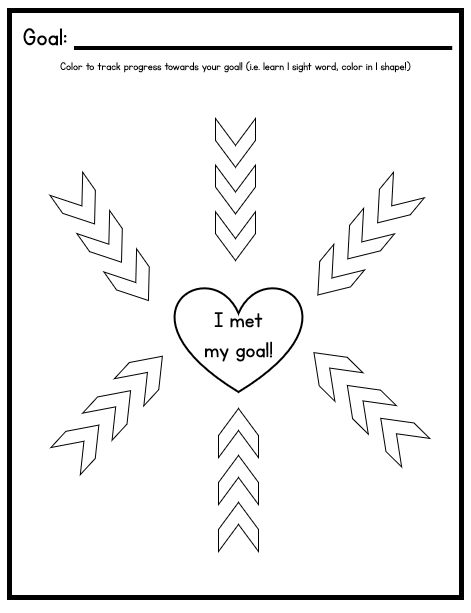
Using the calendar and coloring sheet, my class can revision goals throughout the second semester. Can't wait to see what my goal getters can accomplish!
Share
Tweet
Pin
Share
No comments
Older Posts

About Me

I am a third-year kindergarten ESL teacher in Nashville, TN. I have multi-lingual ESL students who come from 12 different countries and speak 10 different languages! I want to share the things I create to use with them, and have a space for other ESL teachers to come for resources and ideas.

Find Me!

  • Instagram
  • Twitter

Categories

  • ABC
  • activities
  • differentiation
  • freebies
  • games
  • goals
  • kindergarten
  • labels
  • learning names
  • lesson plans
  • math
  • mathematics
  • morning routines
  • name writing
  • New Year
  • phonics
  • PowerPoints
  • professional development
  • SEL
  • tasks
  • thoughts
  • writing

recent posts

Sponsor

Facebook

Blog Archive

  • ▼  2019 (13)
    • ▼  May (1)
      • A New Vision for Mathematics Cycle Three: Assessin...
    • ►  April (1)
    • ►  March (3)
    • ►  February (4)
    • ►  January (4)
  • ►  2018 (8)
    • ►  September (2)
    • ►  August (6)
  • ►  2017 (1)
    • ►  March (1)

Created with by ThemeXpose